

Menu

Menu
Starting College Undeclared: How One DU Student Found International Studies at Korbel
As an undergraduate student, declaring a major is not always easy. Narrowing down career aspirations into one subject matter can feel overwhelming without the proper support. It’s no surprise that many students start college undeclared.
Lila Ash, a current sophomore and double major in International Studies and Criminology, was one of these students. She moved from Philadelphia and started college without declaring a major, but over the course of her first year, she took advantage of the Korbel School’s diverse class roster and flexibility to craft her ideal degree program.
Lila recently shared her journey from undecided to double major who studies abroad, hoping to help other students who are just starting their degrees.
Lila: Mountains. Nature. Access to the outdoors. I love Philly, but there wasn’t anything similar back home. DU’s study abroad program appealed to me, too, so all of the above made it a really easy decision to move out here.
Lila: I always knew I wanted to go to college because a lot of the jobs I was interested in required a bachelor’s degree. Criminology has always been an interest of mine, so I looked at schools with criminology programs. I waited to declare a major, though, because I wasn’t 100% positive that was my only path. I’ve also always been interested in politics and sociology. I’m curious how people interact with each other and with systems, especially with global politics.
Lila: I was looking at the class roster to register and saw a Global Politics course at Korbel. I was already interested in politics and global affairs, so it was the perfect class for me. I had a really great professor, and the class was amazing. I realized I have a genuine interest in this, and from there, I started learning more about Korbel and its programs.
Lila: Professor Keith Gehring. It wasn’t until my first Spring Quarter that I declared my major in International Studies, and that was because of him. He's a fantastic professor and a great instructor, and he really pushed me to make that final step. He helped me realize just how valuable an experience at Korbel could be.
Lila: It's a lot more flexible than a lot of people think. A lot of people at Korbel have a very specific goal, and it's easy to feel intimidated. There are people ready to go to law school or to go into government work, but those aren’t the only paths. The degree is a lot more flexible. You can make it your own. Personally, I don't want to work for the government or become a foreign services officer, but the classes are still very relevant and interesting. It’s very easy to see how they’ll help my career, even if I don’t have my path 100% figured out yet. I think my experience is pretty common here, too.
Lila: There are lots of driven, dedicated people here, especially since there are lots of people here who have a specific career goal in mind. Other students help me stay on track and keep in mind why I'm doing this. It's a really great support system. Everybody's motivating themselves to be the best and most involved students they can be.
Lila: I’m still very interested in Criminology and Global Politics, so seeing how those two things overlap has been really helpful. After starting in International Studies, I looked back on my interests and realized that I was always interested in extremist behavior. Korbel helped me realize I want to pursue a career in counter-extremism through a non-profit or non-government agency.
Lila: Thankfully, there are lots of programs here that complement the International Studies degree. Criminology is one of them, as it’s sort of designed to be a double major. With the support of Korbel and different advisors in my programs, you really have all the support you need.
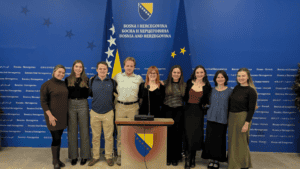
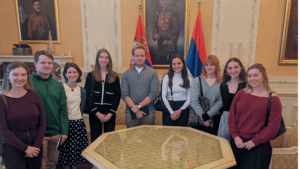
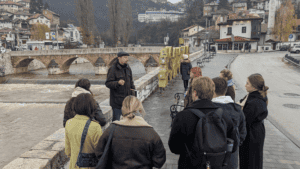
Lila: That was one of my main draws. They’re everywhere. This past Winter Interterm, I was in the Balkans: Serbia, Bosnia, and Croatia. We met with a lot of important figures and officials within those countries. There were some great reporters we met in Serbia who were discussing their work. We met with a bunch of different ambassadors and former ambassadors, as well as a representative at the Office of the High Representative in Bosnia. I met and learned from a lot of really important figures. If I’d gone to school anywhere else, I think I would’ve missed out. It feels unique to Korbel and its connections. Professor Gehring led that trip, and he made the whole experience possible. I’m already planning on more study abroad trips, I’m just not sure which ones yet.
Lila: If you have any kind of interest in politics or policy, whether domestic or on a grater scale, there is a place for you here. There's so much you can do with it. You have the five different concentrations, and there's a ton of different electives and courses. A lot of them can focus on global affairs or particular topics, like this terrorism class I’m taking right now that is super fascinating. As someone interested in counter-extremism, there's a wide range and a lot of depth to the major. Even though you may feel intimidated by the people who get all these fellowships and already know their careers, it doesn’t feel overwhelming or exclusionary once you’re here. There is a place for everybody in this major.
The Korbel School offers two undergraduate majors and minors, International Studies and Public Policy, designed to give students the flexibility, global perspective, and hands-on experience to start impactful careers. With customizable concentrations, immersive study abroad opportunities, and close faculty mentorship, Korbel empowers students to shape a degree that aligns with their goals, even if those goals are still evolving.
Learn more about our degrees, concentrations, and certificates here, and contact our admissions team at [email protected] with any questions. Curious what a Korbel study abroad experience really looks like? Read one student’s firsthand perspective on the Balkans trip and see how learning extends far beyond the classroom.
Copyright ©2026 University of Denver | All rights reserved | The University of Denver is an equal opportunity institution