


Pardee Institute
The Pardee Institute Explores the History of Global Modeling & the Emergence of the Scenario Evolution Process (SEP)
The Pardee Institute Explores the History of Global Modeling & the Emergence of the Scenario Evolution Process (SEP)
The Pardee Institute Explores the History of Global Modeling & the Emergence of the Scenario Evolution Process (SEP)
What’s next for global climate change scenarios through the end of this century and beyond?
At the Pardee Institute’s third Lunch and Learn seminar on April 30th, Director Jonathan Moyer traced the evolution of integrated assessment modeling, from early world models of the 1970s to today’s Shared Socioeconomic Pathways (SSPs), and explained why researchers are now revisiting the assumptions that shape long-term climate futures through an initiative dubbed the Scenario Evolution Process (SEP).
SEP, Moyer explained, is a multi-year, community-led effort to revise and extend the SSPs used across climate research. It aims to be an important knowledge-sharing mechanism for climate change modeling. The International Committee On New Integrated Climate Change Assessment Scenarios (ICONICS) is the main coordinating body. The Pardee Institute, Moyer shared, is actively involved in the effort on several fronts.
The Pardee Institute is hosting the main SEP website and conducting the first global survey to inform the SEP’s strategic direction and planning for 2026, as well as help shape the broader multi-year process through 2030. This survey is open to members of the general public, and to researchers and practitioners familiar with the SSPs.
Pardee’s role in SEP builds on the Institute’s long history in global modeling. Moyer traced that history to the 1970s through the 1980s, when Integrated Assessment Models (IAMs) began linking population, industrialization, natural resources, and other forces within a unified systems framework. That shift, he noted, challenged the idea of a fixed future by showing how policy choices, structural forces, and feedback loops could produce a range of plausible pathways. Pardee’s leading global modeling tool, International Futures (IFs), emerged from this early wave of world modeling and was among the first to broaden this novel systems approach to encompass a wider set of interconnected human, social, and natural system dynamics.
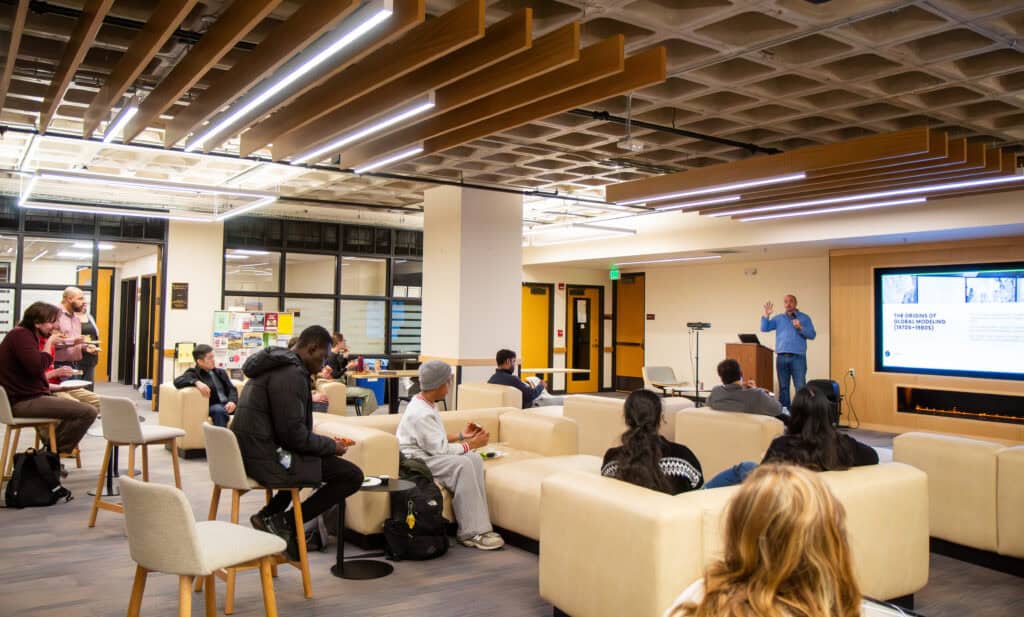
More innovations in climate research followed this shift to a systems approach, Moyer expounded. From the 1990s to the late 2000s, climate scenario development largely followed a “Sequential Modeling” process, with socioeconomic storylines and emissions pathways developed in stages. The SSP framework gave researchers a shared set of five socioeconomic narratives, while Representative Concentration Pathways described different levels of climate forcing. Around 2010, the research community moved to a “Parallel Process,” which decoupled physical climate targets from the SSPs, enabling researchers to conduct multi-dimensional risk assessments.
Moyer noted that researchers have recently recognized the need for a revised set of scenarios as they consider how to expand the SSPs framework to incorporate biodiversity and well-being into climate scenarios, inspiring the SEP effort currently underway.
Following the Lunch and Learn presentation, Moyer fielded questions from the audience regarding the IFs model’s data sources, its forecasting capabilities across 188 countries, and the emergence of the SEP in light of technological advancements like artificial intelligence.
Interested in staying engaged in the evolution process? Explore the SEP website for the latest updates and opportunities to participate, including the global survey.
Give to Pardee

Follow Pardee research, publications, events, and tools that help people reason more clearly about possible futures.
Subscribe
Contact us

Copyright ©2026 University of Denver | All rights reserved | The University of Denver is an equal opportunity institution