Request more info

Founder

Barry Hughes and the Origins of International Futures

Barry B. Hughes developed the International Futures system that anchors the Pardee Institute’s work today.
His decades of scholarship, modeling, and policy-facing analysis helped create the intellectual foundation for Pardee’s approach to long-term global analysis: open-source tools, integrated systems, transparent assumptions, and scenario-based thinking about how the world may change over time.
A model built to examine change across systems
The Pardee Institute’s history begins with a question that has shaped Barry B. Hughes’ work for decades: how can people better understand long-term global change when development, governance, economics, demographics, health, education, environment, and international relations are deeply connected?

Hughes approached that question by building International Futures (IFs), a computer simulation system for studying long-term national, regional, and global issues. IFs was designed to help users examine how changes in one system may affect others over time. Rather than predicting a single future, the model helps users compare plausible futures under different assumptions.

That approach remains central to Pardee’s work today. IFs supports scenario-based analysis across human, social, natural, economic, and geopolitical systems, making assumptions and system relationships more visible for researchers, students, policymakers, and partner organizations.

Bringing IFs to the University of Denver
Hughes began developing what would become IFs while at Case Western Reserve University in the 1970s. In 1980, he brought the model to the University of Denver’s Josef Korbel School of Global and Public Affairs, then known as the Graduate School of International Studies.

At DU, IFs continued to mature as both a scholarly project and a practical tool for long-term analysis. Hughes’ work helped establish a modeling approach that connects empirical data, system dynamics, and human judgment to examine development pathways, global trends, and policy choices over time.

That foundation became the basis for the Frederick S. Pardee Center for International Futures, established in 2006 with support from Frederick S. Pardee. Hughes served as founding director of the Center, which later became the Pardee Institute for International Futures.
Connecting scholarship to policy questions
Hughes’ work helped show how integrated modeling could support both academic research and policy-facing analysis.

He contributed long-term global forecasting and background research to major international and national efforts, including U.S. National Intelligence Council Global Trends reports, the United Nations Environment Programme’s Global Environment Outlook 4, and United Nations Human Development Reports. He also contributed research to projects involving organizations such as the European Commission, RAND, the United States Institute of Peace, and Peru’s National Center for Strategic Planning.

These applications mattered because they connected model structure to real decisions and debates. IFs gave researchers and practitioners a way to test assumptions, compare pathways, and examine how choices in one area, such as education, health, infrastructure, governance, or economic development, could shape outcomes across other systems over time.
A scholarly foundation for Pardee’s work today
Across his books, articles, and model development work, Hughes helped build a field of inquiry around international futures, global modeling, and long-term human development.

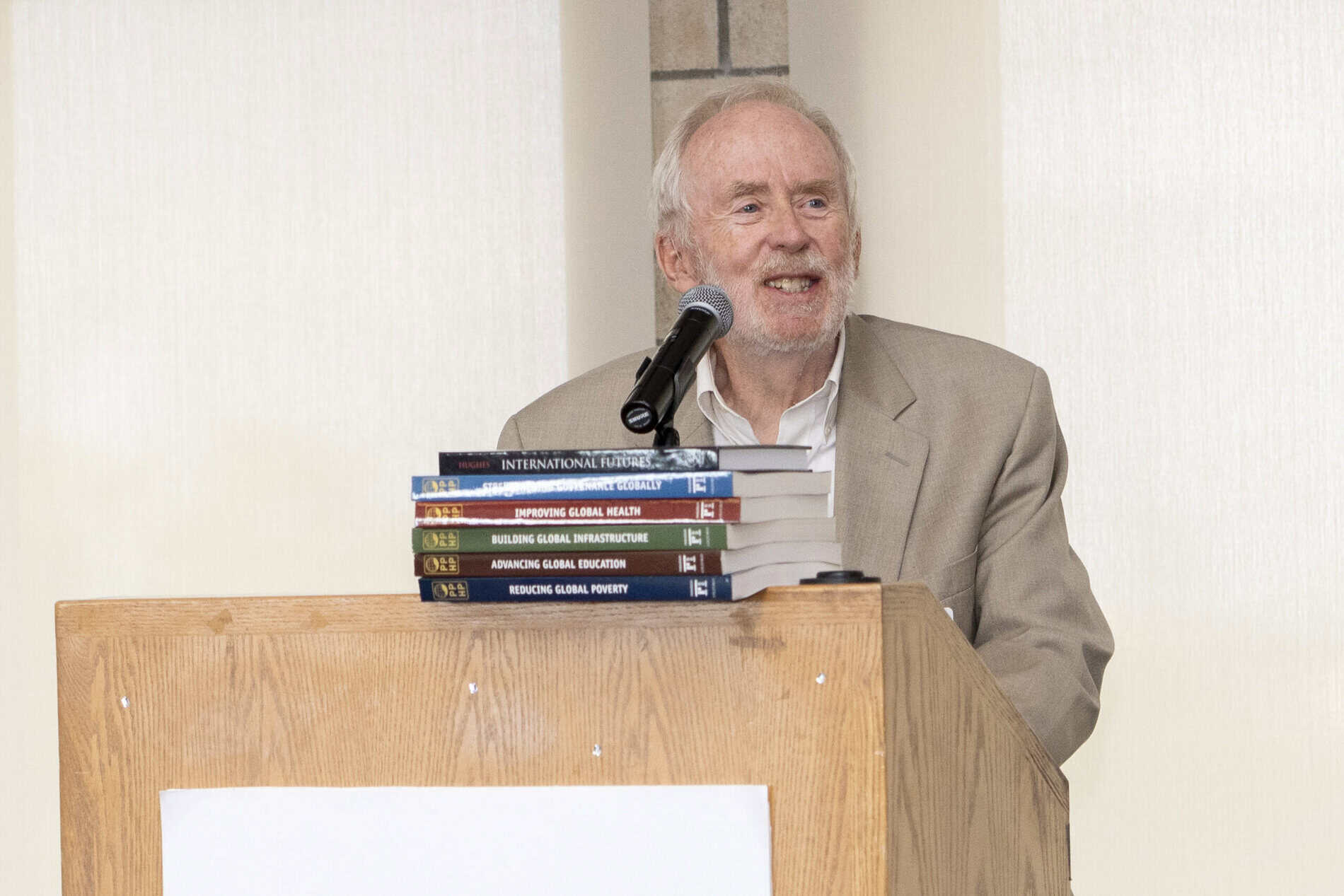
His publications span world modeling, foreign policy, development, education, health, infrastructure, governance, and integrated assessment. Several works in the Patterns of Potential Human Progress series, published during the early years of the Pardee Center, used IFs to examine major global challenges, including poverty, education, health, infrastructure, and governance.

That body of work continues to shape Pardee’s institutional identity. The Institute’s current research, tools, and partnerships grew from the same core premise: long-term questions become more useful when people can examine assumptions, compare scenarios, and see how systems interact.

Help support a global community working toward a more knowable future

Pardee’s open tools, research, and training resources support students, researchers, policymakers, and practitioners around the world. Your gift helps keep that work accessible and strengthens the public research infrastructure behind it.

Give to Pardee

Stay connected with Pardee

Follow Pardee research, publications, events, and tools that help people reason more clearly about possible futures.

Subscribe

Contact us

Copyright ©2026 University of Denver | All rights reserved | The University of Denver is an equal opportunity institution

Website Accessibility
crossmenuchevron-downarrow-rightcross-circle