

Join us for Virtual Open House on December 4, 2026. Register now.
Pardee Institute
Collin Meisel on Pakistan TV: A Strait of Hormuz agreement could come before a broader U.S.-Iran deal
Join us for Virtual Open House on December 4, 2026. Register now.
Collin Meisel on Pakistan TV: A Strait of Hormuz agreement could come before a broader U.S.-Iran deal
Collin Meisel on Pakistan TV: A Strait of Hormuz agreement could come before a broader U.S.-Iran deal
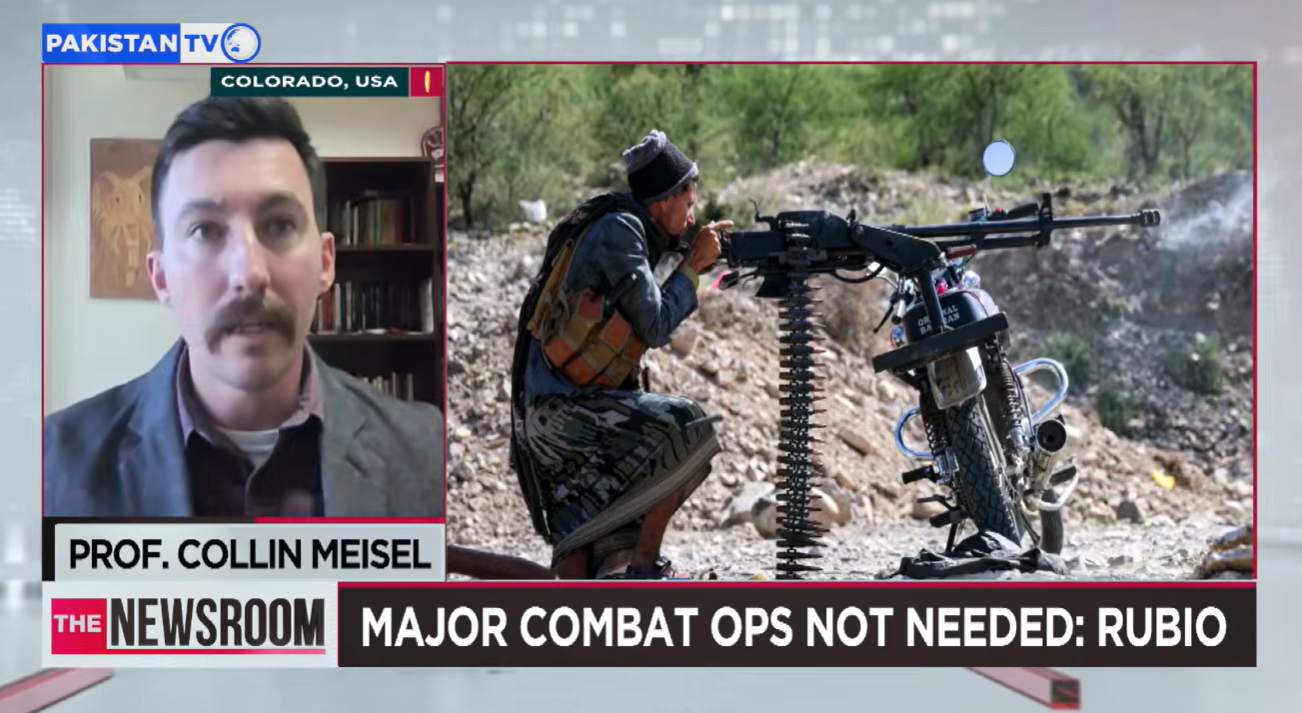
A comprehensive U.S.-Iran peace deal may remain out of reach, but regional actors could still work toward a narrower agreement to restore energy shipments through the Strait of Hormuz. That was Pardee Institute Director of Analysis Collin Meisel’s central point when he joined Pakistan TV’s Newsroom with Sana on November 10 to discuss what could come next in the U.S.-Iran conflict following the U.S. midterm elections.
Meisel framed the outlook as a set of scenarios, noting that “war is contingent and anything could happen,” and that the same is often true of diplomacy. In one scenario, regional actors coordinate to allow energy shipments through the strait while fighting continues. That could ease pressure on economies in the region and elsewhere. Meisel pointed to Ukraine as an example of how some trade can continue during war: energy shipments continued through its territory early in Russia’s war. He noted that regional planners must consider several possible outcomes, including one in which cooperation fails to materialize.
Whether that kind of cooperation takes hold depends heavily on regional actors. Meisel said Pardee’s long-term power forecasts suggest regional actors will likely have greater ability to act as both “regional builders and regional spoilers,” while traditional powers like the United States may find it harder to impose their will. He pointed to Qatar and Pakistan as mediators, and to the Houthis as an actor that could complicate efforts to reach an agreement. He added that Israel, acting on its own national interests, could also slow progress towards a deal.
The conflict’s economic costs could give governments another reason to pursue a limited agreement, Meisel said. He highlighted rising prices for middle- and upper-middle-class families. Preliminary scenario analysis by Pardee Director Jonathan Moyer and Director of Research Development Taylor Hanna, using International Futures (IFs), Pardee’s open-source, integrated assessment model, suggests that under the conditions they examined, the conflict could push millions of people worldwide into poverty.
Meisel also identified several barriers to a broader deal. He said the United States has an interest in reaching an agreement, but the two sides remain divided over key terms, and each wants the other to act first. He described “a major trust deficit,” citing U.S. attacks on Iran that followed earlier negotiations. Even with those barriers in place, he said, regional coordination could make a limited agreement on energy shipments possible.
Watch Meisel’s segment on Pakistan TV
Give to Pardee

Follow Pardee research, publications, events, and tools that help people reason more clearly about possible futures.
Subscribe
Contact us

Copyright ©2026 University of Denver | All rights reserved | The University of Denver is an equal opportunity institution