

Join us for Open House on November 13, 2026. Register now.

Pardee Institute
How far does the impact of a war in the Middle East extend?
Join us for Open House on November 13, 2026. Register now.
How far does the impact of a war in the Middle East extend?
How far does the impact of a war in the Middle East extend?
When shipping through the Strait of Hormuz slows, the effects don't stay in the Persian Gulf. At the Pardee Institute’s October 29 Lunch and Learn, Director of Research Development Taylor Hanna and Director Jonathan Moyer shared early research, conducted in collaboration with UN Women, that traces how higher fuel and fertilizer costs could affect households thousands of miles away.
Using International Futures (IFs), Pardee’s open-source, integrated assessment model, the team compared a pre-conflict baseline with a shorter war ending in 2026 and a longer war lasting through 2028. Because IFs links energy, agriculture, the economy, and human development in one model, the team could follow the war’s effects from one system to the next. For example, the scenarios examined how disrupted shipping through the Strait of Hormuz could raise fuel costs and constrain fertilizer supplies, reducing crop production and making food less affordable.
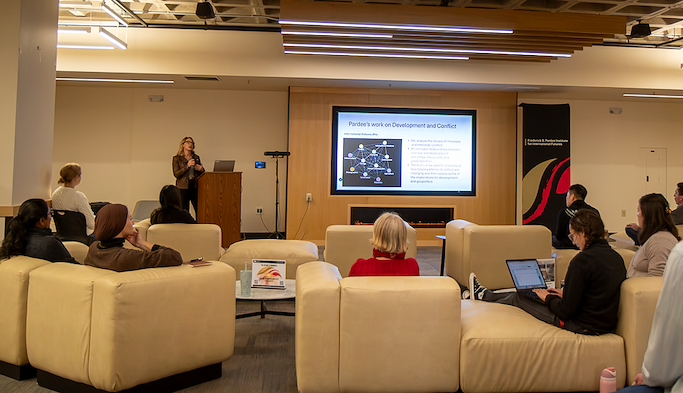
The presentation showed how those effects could extend far from the region, including to countries in Central and Southern Asia that depend on Gulf fuel and fertilizer. The effects also differ for women and men. Using IFs to examine these differences, the team’s preliminary results suggest a larger increase in food insecurity among women than men, with effects persisting beyond the fighting. In the scenarios presented, a longer conflict could compound the hardship.
A lively discussion followed, with attendees raising several questions about the findings. One asked why the effects in Africa appeared smaller than in South Asia. In the scenarios, the answer is exposure: South Asia relies heavily on Gulf fuel and fertilizer, while lower chemical fertilizer use across much of Sub-Saharan Africa softens the hit to harvests. Others noted how useful this kind of analysis could be for understanding the war’s reach beyond the region.
The regional comparison illustrates why distance from the fighting alone does not determine exposure. Dependence on imported fuel and fertilizer can transmit disruptions across borders, while differences in agricultural production and economic conditions shape how those disruptions affect households.
The findings remain preliminary. For readers interested in learning how to use IFs to develop and compare scenarios, visit Learn IFs to learn about our online course series. Watch for future Lunch and Learn events connecting the Korbel community with Pardee’s research and its policy applications.

Give to Pardee

Follow Pardee research, publications, events, and tools that help people reason more clearly about possible futures.
Subscribe
Contact us

Copyright ©2026 University of Denver | All rights reserved | The University of Denver is an equal opportunity institution